PlotLoom · continuity for serial fiction
The story engine that keeps your canon consistent.
You’re a hundred chapters deep. The story bible is a 40-tab spreadsheet you stopped trusting somewhere around chapter sixty — and right now, your comment section catches the slips before you do. Wherever you post — Royal Road, Wattpad, Vella, AO3 — the loom reads the chapter before your readers do.
Nothing to install Never trained on your work Export everything, always.
Fig. 01 — The writing room, under the loom
Actual product · unretouched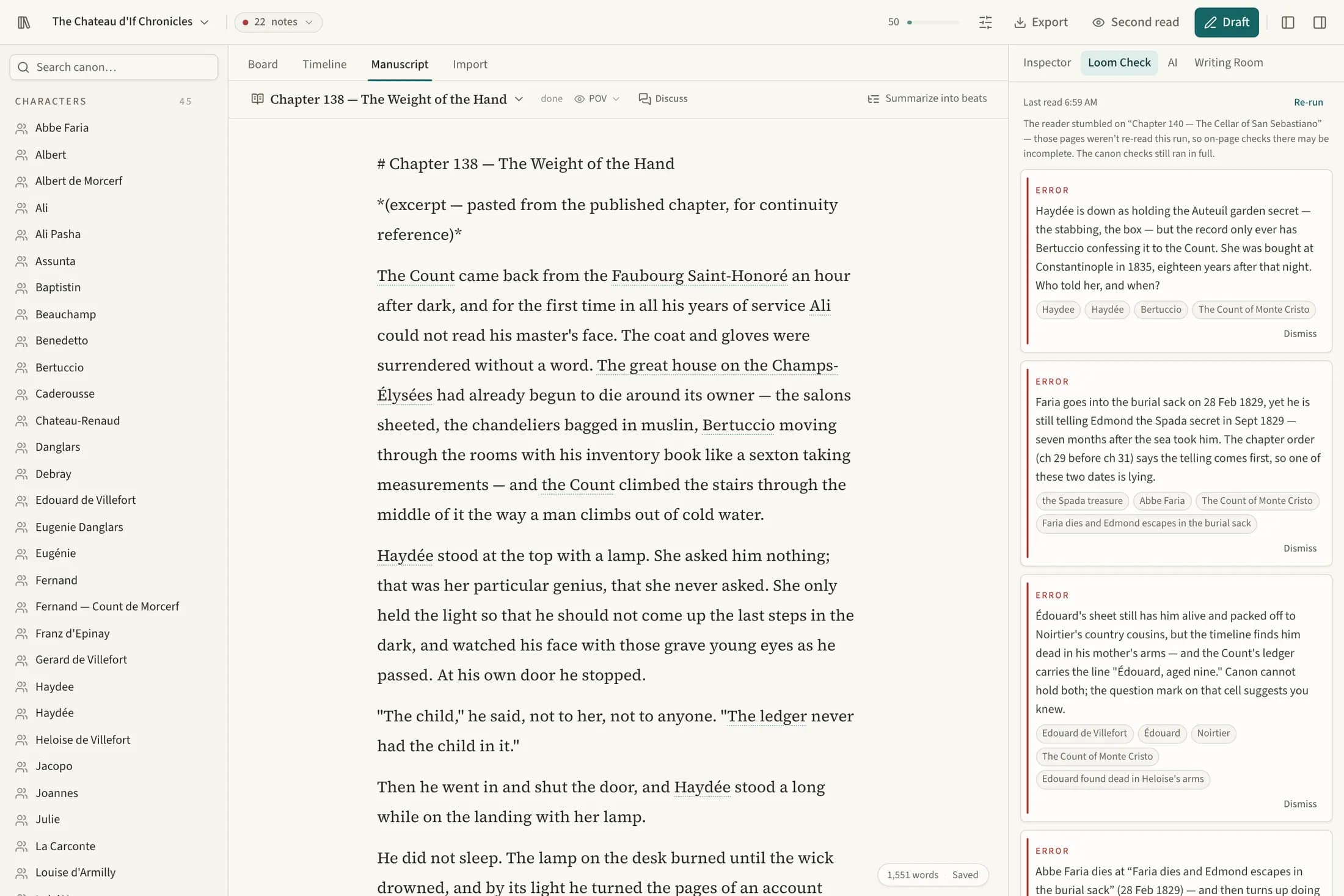
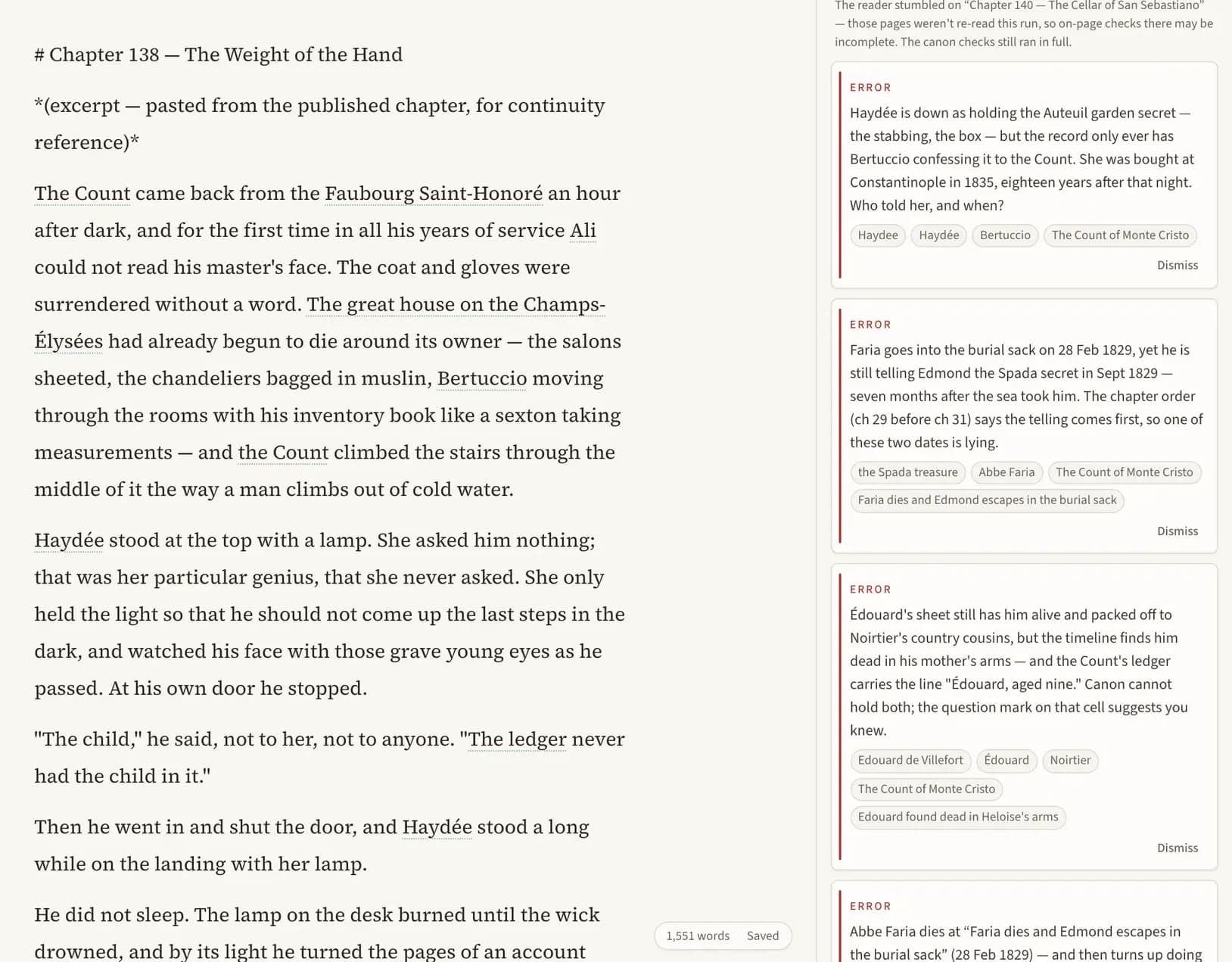
The loom does the cold reading; the room stays warm — paper, serif, ink. This is the product, unretouched; we did not paint it dark for the poster.Every note in that margin is a real finding — on The Count of Monte Cristo, public domain, so we can print them verbatim. Your chapters get the same read, in private.
The Weekly Loop.
Bring in the mess
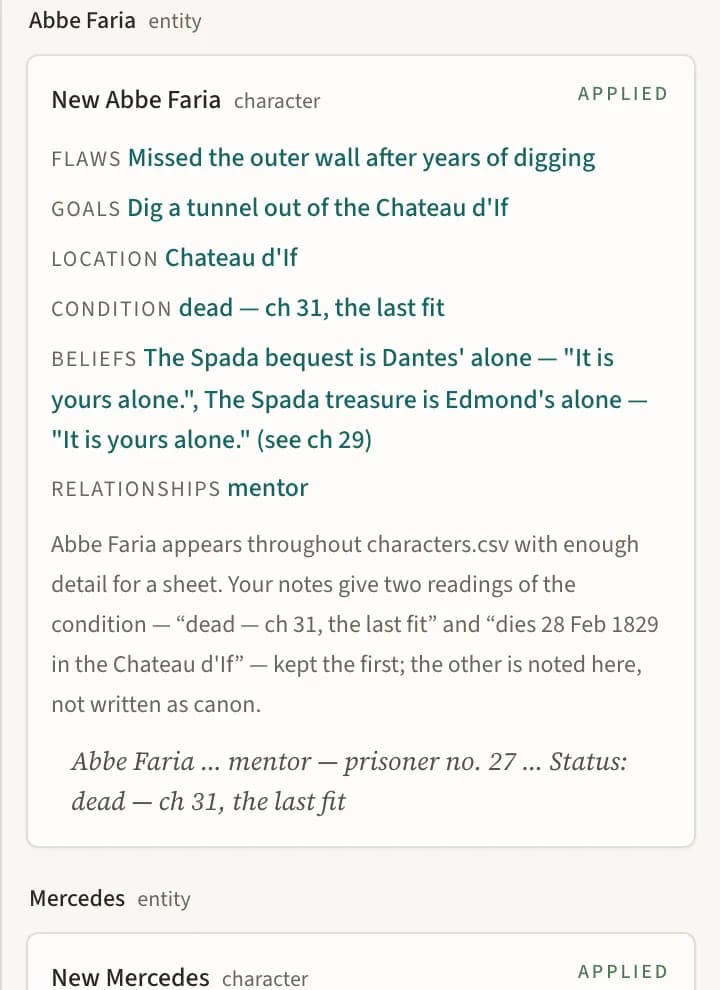
Paste the spreadsheet. Dump the docs, the margin notes, the mess. The engine proposes structured character sheets — flaws, goals, beliefs, condition, each with its source line from your notes — world rules, and a lossless record of everything your serial has ever asserted. Nothing enters canon until you approve it.
The loom proposes. You approve.
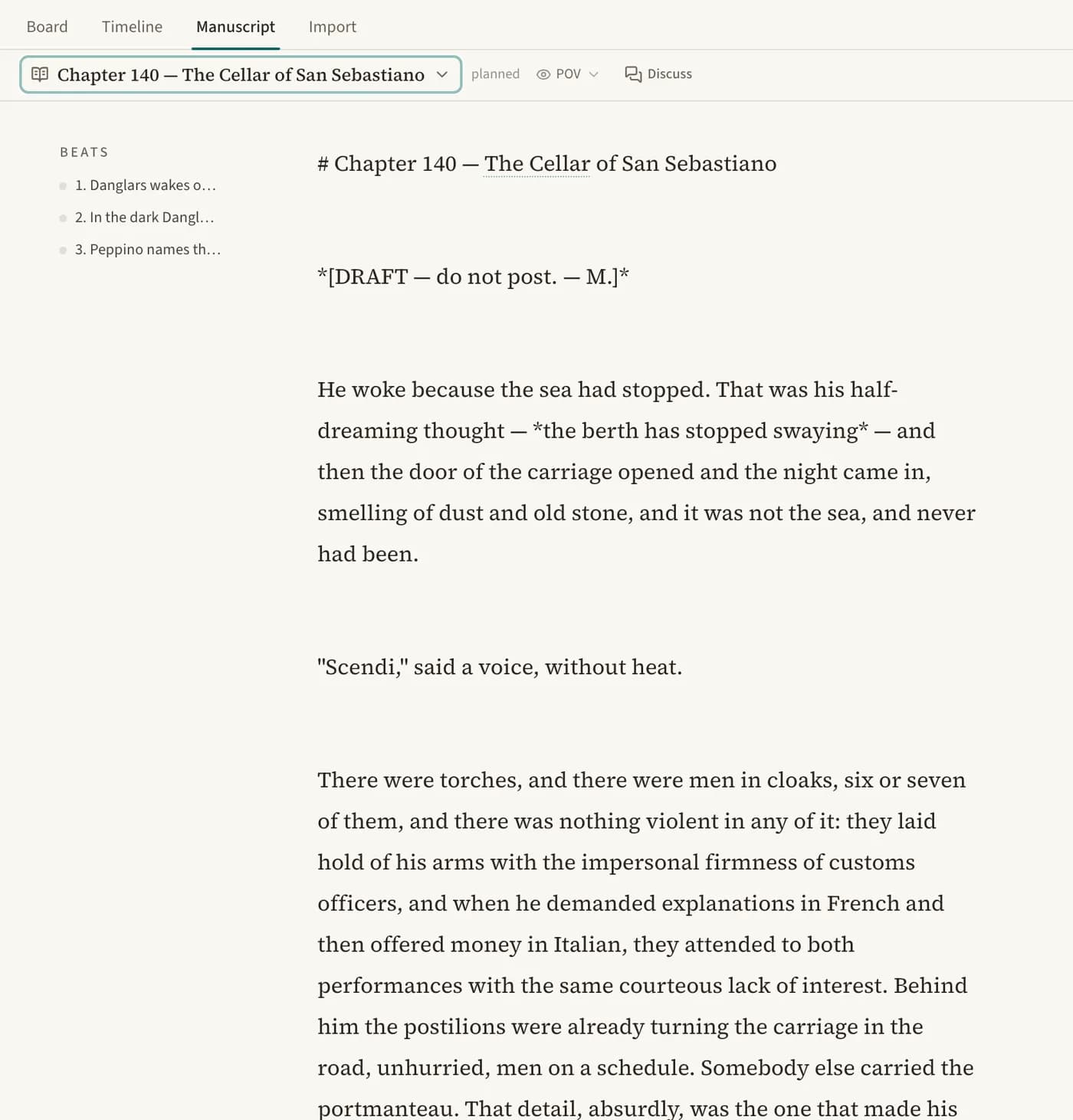
Plan & Write
A serif manuscript editor with your characters’ current state one hover away. The Writing Room drafts against canon — grounded in what is actually true at chapter 84, not what was true at chapter 12. Every suggestion arrives as a reviewable proposal. Nothing edits your prose silently.
Loom Check
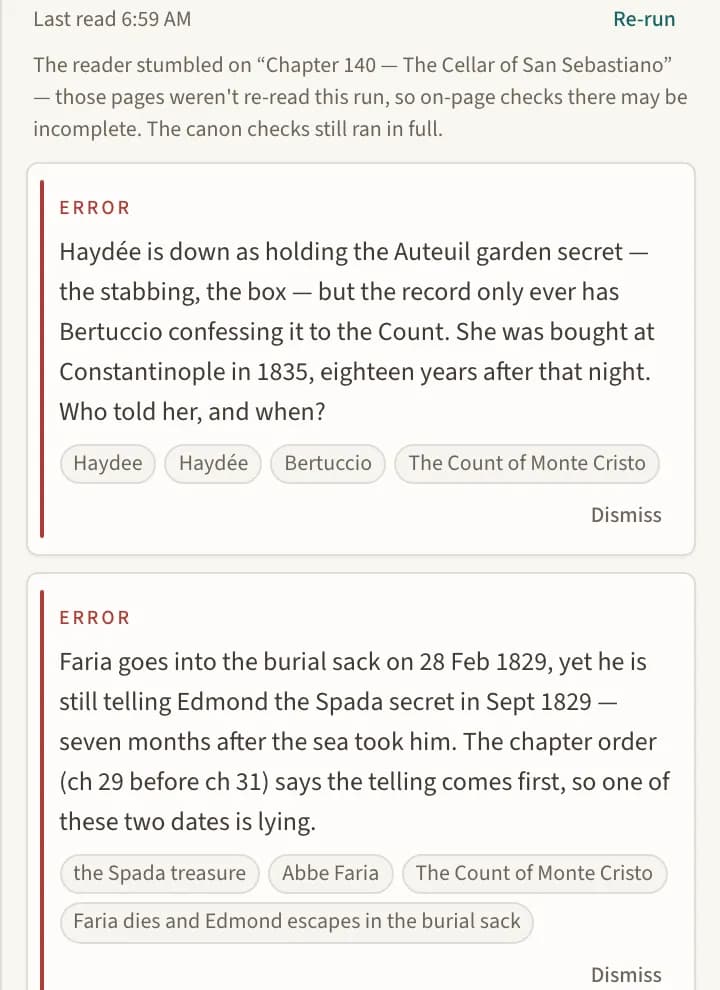
The loom reads your chapter against everything the story has already promised: timeline slips, dead characters acting, broken world rules, threads you dropped forty chapters ago. Each note pins the canon it stands on and asks the question a cold reader would — “Who told her, and when?” — verbatim, in the frame at right.
“…so one of these two dates is lying.”— the loom, reading chapter 138
Leave whenever. Take everything.
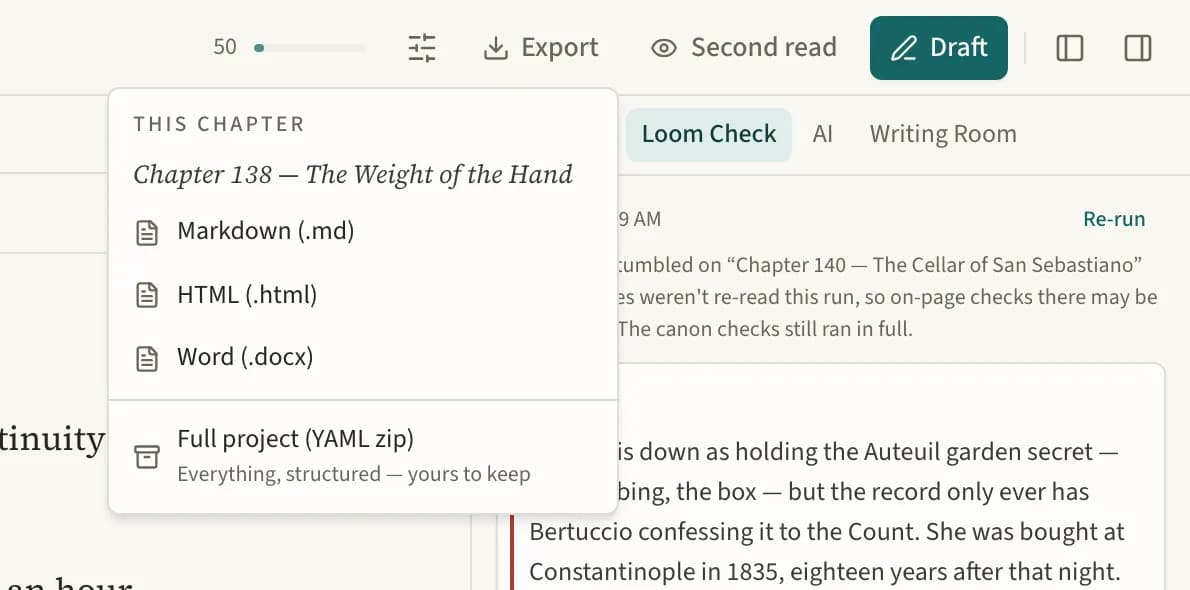
Print-ready Markdown, HTML, and .docx out. A full-project archive of the entire canon — characters, rules, every thread — readable by you, your tools, or your successor. The menu says it plainly: “Everything, structured — yours to keep.”
Your story stays yours. Never used to train anyone’s model — the plain-language policy says so, in writing.
Sec. 03 — The difference
A wiki vs. a loomThe wiki you abandon
Every other tool gives you a wiki to keep by hand. It dies the moment you stop updating it.
- Manual upkeep, forever
- No link to the actual prose
- Trust decays chapter by chapter
- Contradictions found by readers
The loom that reads your pages
The only tool where canon is checked against your actual prose — with a record of every change you approve.
- Canon drawn from your chapters
- Every check reads the real pages
- A record of every change you approved, and when
- Contradictions found before you publish
Sec. 04 — Pricing
Two plans · nothing hiddenFree
$0
Get the canon out of the spreadsheet.
- 1 project
- Full canon library and chapter board
- 20 Loom Checks a month
- Full archive export, always — plain files that open anywhere
Pro The Loop
$15 /mo
The weekly loop, all the way around.
- Everything in Free
- Unlimited Loom Checks
- Manuscript editor with inline margin flags
- Patterns — beat templates and advisory rules
- A monthly allowance of AI reads and drafts
AI drafting, bible import, and the Writing Room cost us real money each run, so they’re metered honestly. Every account starts with an allowance; Pro adds a monthly one, and top-ups open alongside it. No surprise bills.
Now weaving at plotloom.ink.
No waitlist — sign up and move the bible in tonight. Not ready to move eight years of work? Leave your email and we’ll write when there’s something new on the loom.